
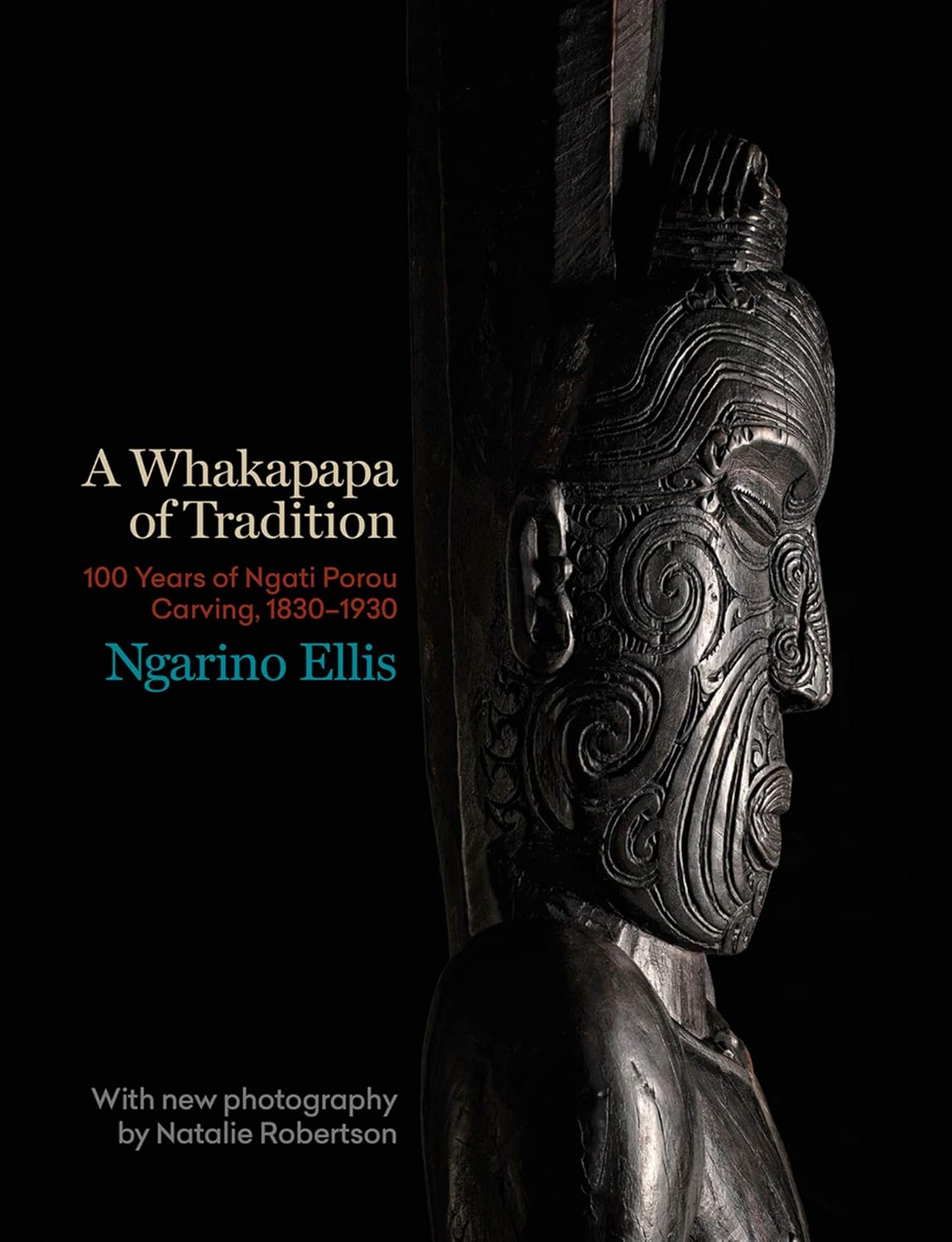
A Whakapapa of Tradition: One Hundred Years of Ngato Porou Carving, 1830-1930
Product details
| Management number | 231862340 | Release Date | 2026/06/18 | List Price | US$16.00 | Model Number | 231862340 | ||
|---|---|---|---|---|---|---|---|---|---|
| Category | |||||||||
From the emergence of the chapel and the wharenui in the nineteenth century to the rejuvenation of carving by Apirana Ngata in the 1920s, Maori carving went through a rapid evolution from 1830 to 1930. Focusing on thirty meeting houses, Ngarino Ellis tells the story of Ngati Porou carving and a profound transformation in Maori art. Beginning around 1830, three previously dominant art traditions – waka taua (war canoes), pataka (decorated storehouses) and whare rangatira (chief's houses) – declined and were replaced by whare karakia (churches), whare whakairo (decorated meeting houses) and wharekai (dining halls). Ellis examines how and why that fundamental transformation took place by exploring the Iwirakau School of carving, based in the Waiapu Valley on the East Coast of the North Island. An ancestor who lived around the year 1700, Iwirakau is credited for reinvigorating the art of carving in the Waiapu region. The six major carvers of his school went on to create more than thirty important meeting houses and other structures. During this transformational period, carvers and patrons re-negotiated key concepts such as tikanga (tradition), tapu (sacredness) and mana (power, authority) – embedding them within the new architectural forms whilst preserving rituals surrounding the creation and use of buildings. A Whakapapa of Tradition tells us much about the art forms themselves but also analyzes the environment that made carving and building possible: the patrons who were the enablers and transmitters of culture; the carvers who engaged with modern tools and ideas; and the communities as a whole who created the new forms of art and architecture. This book is both a major study of Ngati Porou carving and an attempt to make sense of Maori art history. What makes a tradition in Maori art? Ellis asks. How do traditions begin? Who decides this? Conversely, how and why do traditions cease? And what forces are at play which make some buildings acceptable and others not? Beautifully illustrated with new photography by Natalie Robertson, and drawing on the work of key scholars to make a new synthetic whole, this book will be a landmark volume in the history of writing about Maori art. Read more
| ASIN | B01B11RNFG |
|---|---|
| XRay | Not Enabled |
| ISBN13 | 978-1775587439 |
| Language | English |
| File size | 42.3 MB |
| Page Flip | Enabled |
| Publisher | Auckland University Press |
| Word Wise | Not Enabled |
| Print length | 596 pages |
| Accessibility | Learn more |
| Screen Reader | Supported |
| Publication date | March 21, 2016 |
| Enhanced typesetting | Enabled |

Customers who viewed this product also viewed
Camping Coolers




Correction of product information
If you notice any omissions or errors in the product information on this page, please use the correction request form below.
Correction Request Form